Contenido principal
2025
CSN participates in the 58th Safety Standards Commission organised by the IAEA

A delegation led by Commissioner Javier Dies contributes to the approval of revised international safety requirements
The Chair of the Nuclear Security Guidance Committee, Pedro Lardiez, intervened during the high-level sessions
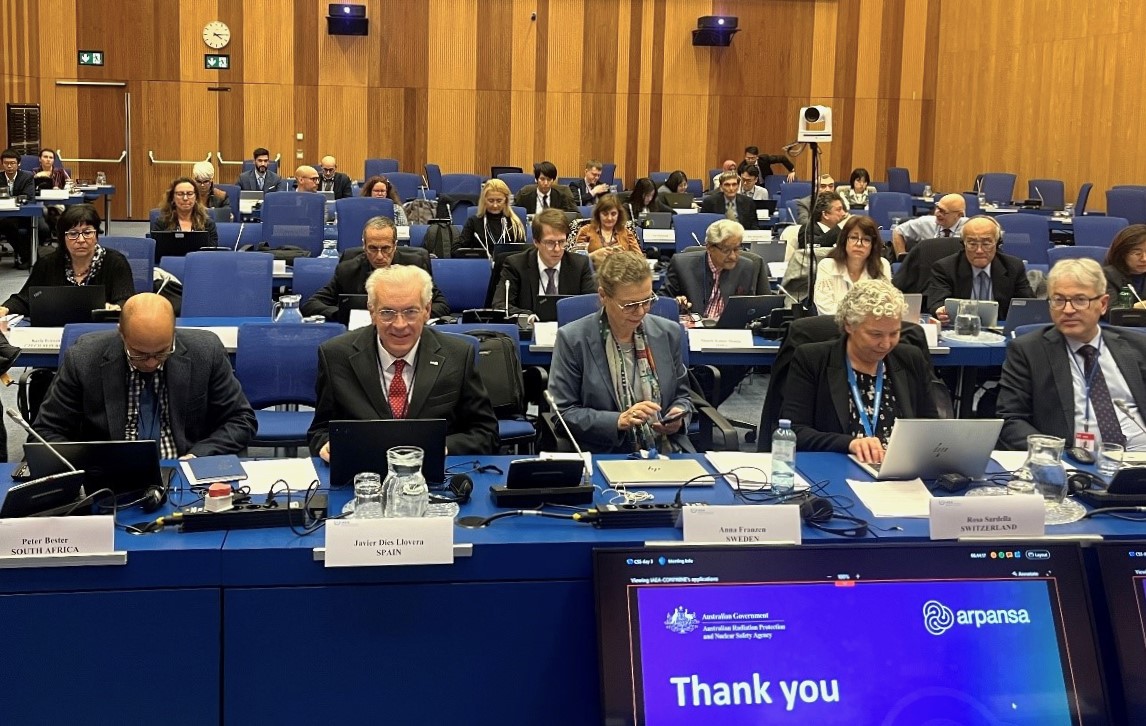
A delegation from the Spanish Nuclear Safety Council (CSN), led by Commissioner Javier Dies, participated this week in the 58th meeting of the Commission on Safety Standards (CSS) organised by the International Atomic Energy Agency (IAEA) in Vienna from the 8th to the 11th of December. This meeting was chaired by the Director General of the Swiss regulator (ENSI), Mark Kenzelmann.
The CSS is composed of 25 members from nuclear regulators across 25 countries. During the meeting, various proposals for documents on regulatory frameworks, the supervision of safety standards established by the IAEA, and international standards were reviewed. This ensures that global nuclear and emergency response infrastructure operates under robust and unified safety parameters.
The IAEA Deputy Director-General and Head of the Department of Nuclear Safety and Security, Katherine Herviou, highlighted the value of Safety Standards, particularly for countries embarking on nuclear power programmes. She also stressed out the work undertaken to improve the standards-setting process.
The chairs of the various Standards Committees reported on the progress made over the past year and upcoming regulatory projects. Within this framework, the head of the CSN Nuclear Security Area at the CSN, Pedro Lardiez, in his capacity as Chair of the Nuclear Security Guidance Committee (NSGC), presented the latest developments regarding this committee.
On this matter, the proposed revisions of the safety requirements for the site assessment of nuclear facilities (SSR-1) and the safety requirements for the preparedness and response to nuclear or radiological emergencies (GSR-Part 7) were approved.
Additionally, the action plan to develop the long-term strategy for these standards was presented. The plan focuses on critical safety aspects, such as new emerging technologies (including AI and Fusion), the harmonisation of regulations for new reactors (such as Small Modular Reactors - SMRs), and ensuring that technical requirements remain high-level and technologically inclusive. The DS560 guide on the development and application of Level 3 Probabilistic Safety Assessment (PSA) for nuclear power plants was also presented.
Among the various points addressed in his interventions, Commissioner Dies highlighted the importance of incorporating best practices and lessons learned from reactors that have already entered long-term operation (LTO) into the regulatory framework.
The IAEA Commission on Safety Standards
The Commission on Safety Standards was established in 1996, alongside four specialised committees covering the various branches of nuclear, radiation, transport, and waste safety, as well as emergency preparedness and response. It plays a primary role on the oversight of IAEA safety standards and provides advice to the Director General on all regulatory safety aspects.
The standards approved by the Commission are used as a reference by the majority of Member States worldwide during the development or modification of their nuclear and radiological safety regulations.